The second roadmap in Protocol Labs' Brain–Computer Interface Roadmap Series.
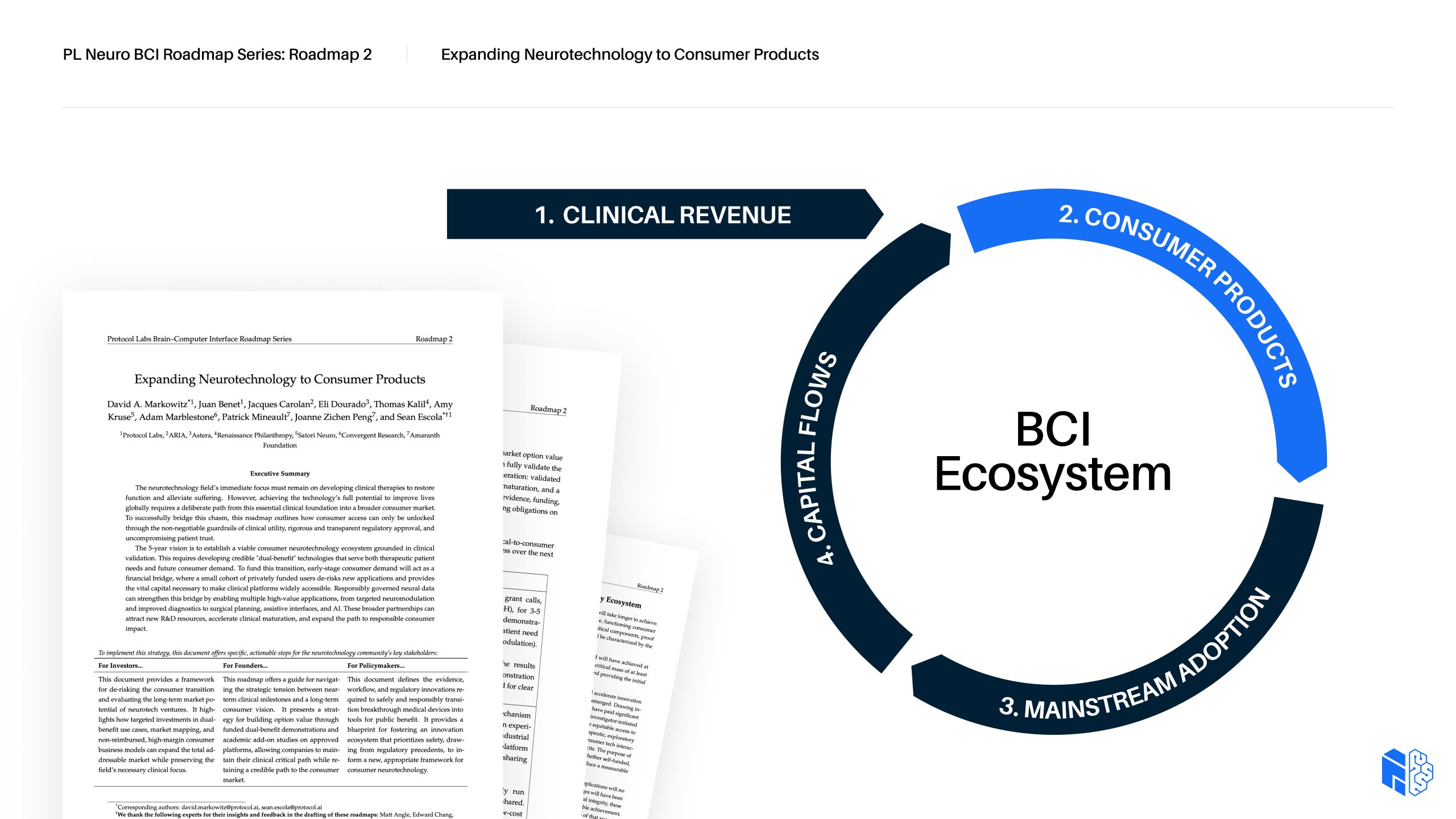
Building on the series overview and the first roadmap on clinical revenue, this report focuses on expanding neurotechnology to consumer products: the technical, regulatory, and market steps required to move brain–computer interfaces beyond the clinic and into everyday use. It maps the levers that could unlock durable consumer applications and the bottlenecks that stand in the way.
The report was authored by David A. Markowitz, Juan Benet, Jacques Carolan, Eli Dourado, Thomas Kalil, Amy Kruse, Adam Marblestone, Patrick Mineault, Joanne Zichen Peng, and Sean Escola, and published on Zenodo in May 2026 (CC BY 4.0).
Read the report: via DOI (10.5281/zenodo.20119636) · Download PDF
A Roadmap for Consumer Neurotechnology
Neurotechnology is advancing rapidly, and every year brings new demonstrations of its medical potential, from restoring movement and speech to people with paralysis, to treating conditions like Parkinson's disease and depression.
But could neurotechnology eventually become a consumer technology? Is that something we want? And if so, what kinds of consumer applications are actually plausible in the near term, given the current state of the science, medicine, and regulation?
This new roadmap paper from a group of researchers, technologists, investors, and policy experts attempts to provide grounded answers.
Its central premise is that any viable consumer ecosystem must emerge from technologies developed first for patients. In other words: consumer neurotechnology should grow out of medicine, rather than bypassing it.
To illustrate the potential of neurotechnology for meeting everyday needs, the authors point to something both ordinary and easy to overlook: the widespread use of chemicals to improve focus, promote relaxation, and support sleep.
Consumers already spend hundreds of billions of dollars annually on products to regulate brain state, including caffeinated beverages, alcohol, nicotine, supplements, and sleep aids.
These are whole-body interventions, often associated with side effects, dependency risks, and limited efficacy. Neurotechnology, the paper suggests, could eventually offer more targeted, on-demand alternatives to many of these substances.
Importantly, this is not a free-for-all consumer market. Instead, the roadmap envisions a gradual expansion of medical technologies that have been proven safe and effective, with clear evidence that devices can be implanted and removed safely. The evolution of hearing aids — from regulated medical devices to mass-market consumer products — offers an important precedent.
The roadmap also addresses one of the field's central ethical concerns: that consumer neurotechnology could divert attention and resources away from patients and toward wealthy early adopters. Instead, the authors propose something closer to a "Tesla Roadster" model, in which a small number of self-funded early users help subsidize manufacturing scale, improve procedures, and accelerate the broader development of the technology. They note that this approach will only earn public trust if it makes neurotechnology better, safer, and more widely available for medical users.
Ultimately, the paper suggests that the most realistic near-term path for consumer neurotechnology is also the least science-fictional: a gradual expansion of clinically validated technologies into areas where people already spend enormous sums trying to improve their mental performance and well-being.
This roadmap is the second installment of the Protocol Labs Brain–Computer Interface (BCI) Roadmap Series, which defines a strategic playbook for accelerating progress in BCI:
- Overview — A Strategic Vision for the Future of Brain–Computer Interfaces
- Roadmap 1 — Smoothing the Path to Clinical Revenue
- Roadmap 2 — Expanding Neurotechnology to Consumer Products
- Roadmap 3 — Popularizing the Promise of Neurotechnology
- Roadmap 4 — Increasing Venture Capital Flows (coming soon)